
What if changing the world begins with something as simple—and as challenging—as learning to open our hearts?
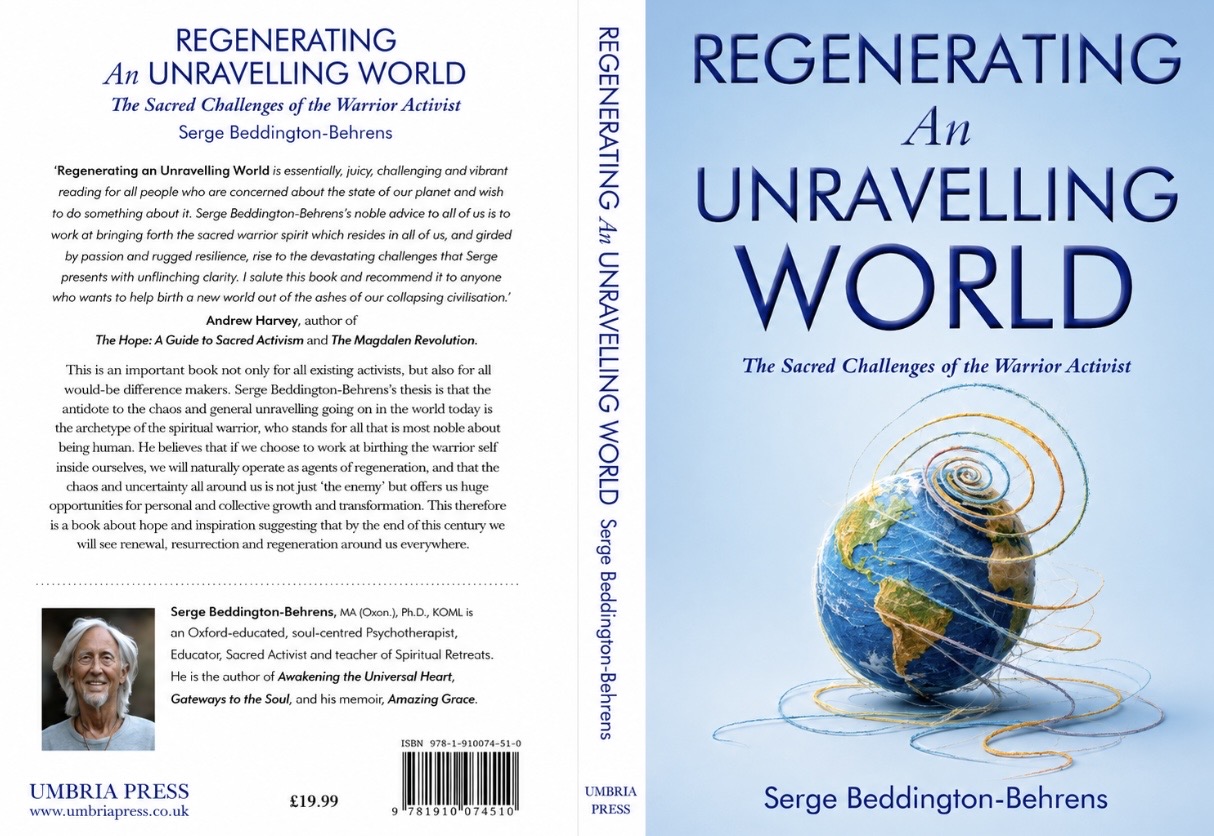
In his new book, Regenerating an Unravelling World: The Sacred Challenges of the Warrior Activist, psychotherapist and spiritual educator Serge Beddington-Behrens argues that the world does not simply need more determination, political action or intellectual solutions. It needs more heart.
For Beddington-Behrens, becoming a spiritual warrior activist means developing the courage to engage with the world’s problems while also cultivating qualities such as love, kindness, compassion, beauty, wisdom and joy.
This idea becomes particularly important in the book’s chapter “Becoming a Warrior of the Heart,” where he argues that the sacred warrior path needs to be heart-centred if it is genuinely going to contribute to regeneration.
Why Does Activism Need Heart?
Beddington-Behrens believes that modern society has become heavily focused on qualities such as power, will and determination, while softer qualities have often been treated as less important.
He particularly questions a culture in which people are encouraged to live primarily “in their heads” while becoming increasingly disconnected from their emotional and spiritual lives.
For him, this imbalance matters.
A person may have strong opinions about politics, social justice or the state of the world, but if their activism becomes disconnected from compassion, it can easily reproduce some of the very divisions it is trying to overcome.
Sacred Activism therefore asks for something more demanding: courage with heart.
The Heart Is Not the Opposite of Strength
The idea of a warrior with an open heart may initially sound contradictory.
Traditionally, warrior qualities are associated with toughness, discipline, courage and the ability to confront adversity.
Beddington-Behrens does not reject those qualities. He believes they are essential.
But he argues that strength without heart can become destructive.
The sacred warrior therefore has to develop both sides: the courage to stand up for what matters and the openness to remain connected to other human beings while doing so.
In this sense, compassion is not weakness. It becomes part of the warrior’s strength.
From Disconnection to Connection
The idea of the open heart is closely connected to another major theme in Regenerating an Unravelling World: disconnection.
Beddington-Behrens describes disconnection as one of the great wounds of modern humanity. People can become separated from themselves, from their own hearts, from other people and from the wider world.
That separation can then influence the way we see those who are different from us.
We begin to divide people into categories: people like us and people unlike us, people who belong and people who do not, people we understand and people we fear.
For Beddington-Behrens, regeneration requires reversing that process.
The more connected we become to ourselves and to others, the greater our capacity to act from a place of humanity rather than separation.
Why Friendliness Can Be a Radical Act
One of the more unexpected ideas in the book is the importance Beddington-Behrens gives to friendliness.
He argues that living in a world with insufficient heart also means living in a world with insufficient friendliness. People can become suspicious or hostile towards those from different cultures, religions, classes, races or political backgrounds.
For a Sacred Activist, being friendly is therefore not simply a matter of being pleasant.
It can become an act of regeneration.
Beddington-Behrens describes genuine friendliness as something that involves kindness and an intention to include rather than exclude. He also connects it to his own experiences, recalling moments when the friendliness of other people helped him when he was young, lost or struggling.
The idea is simple but powerful: the way we treat people in everyday encounters contributes to the kind of society we create.
Making Space for People Who Feel Left Out
This becomes particularly significant when Beddington-Behrens discusses people who find themselves on the margins of society.
He writes about immigrants and asylum seekers, homeless people, addicts and others who can easily become society’s “cast-offs”. Rather than automatically judging them, he asks readers to consider the deeper social and psychological circumstances that may have contributed to their situations.
For the warrior activist, this requires self-awareness as well as compassion.
Beddington-Behrens acknowledges that we do not need to be completely healed or free from vulnerability before we can help others. What matters is becoming aware of our own vulnerabilities so that we do not simply project onto other people the parts of ourselves that we would rather not see.
That makes his vision of activism deeply personal.
Before trying to change everyone else, we have to become more conscious of the way we ourselves relate to the world.
Friendship as Part of Regeneration
The book also explores friendship as something that requires genuine effort.
Beddington-Behrens distinguishes between people we are friendly towards and those with whom we develop deeper friendships. He argues that meaningful relationships require time, attention and a willingness to maintain connection.
For someone committed to Sacred Activism, this matters because social change is ultimately about people.
It is easy to talk about humanity in abstract terms.
It is much harder to remain open-hearted when faced with an individual whose opinions, background or behaviour challenge us.
That is where the warrior of the heart is tested.
A Different Vision of Activism
Regenerating an Unravelling World ultimately presents activism as something broader than political campaigning.
It can mean taking a stand against injustice. It can mean creating new ideas or structures. It can mean challenging destructive systems.
But it can also mean becoming more connected, more generous, more courageous and more capable of treating other people with humanity.
Beddington-Behrens believes these dimensions cannot be separated.
The book’s larger message is that a regenerated world will not simply be produced by changing institutions. It will also require people to change the quality of their own being.
For Serge Beddington-Behrens, perhaps one of the first places to begin is not outside ourselves at all.
It is the heart.

